Metal wire

Group Nirmal: engineering tomorrow’s power grids
India’s renewable energy expansion is transforming the power grid, with installed capacity exceeding 180 GW and a target of 500 GW by 2030. This shift necessitates that transmission systems support higher power densities over longer distances, making grid reinforcement and evacuation capability as crucial as generation capacity. Consequently, the industry must focus on the operational reliability of conductors and core wires under increased thermal, mechanical, and environmental stress. As a result, there is a clear trend toward performance-led capacity expansion, with higher-strength aluminum conductors and improved steel core wires enabling 20–40% higher current carrying capacity compared to conventional options. Reconductoring and uprating projects now allow utilities to enhance capacity by 1.5–2× within existing corridors, driving manufacturers to invest in process control and testing infrastructure rather than simply increasing volume.
At Nirmal Wires, the growth strategy has been shaped by these same structural changes. Renewable-led grid expansion stands out as a long-duration shift in technical requirements rather than a short-term demand spike. This perspective has guided the company’s decision to strengthen aluminum conductor capability while maintaining tight control over metallurgy, dimensional consistency, and coating performance—parameters that directly influence conductor life under elevated operating temperatures and cyclic loading.
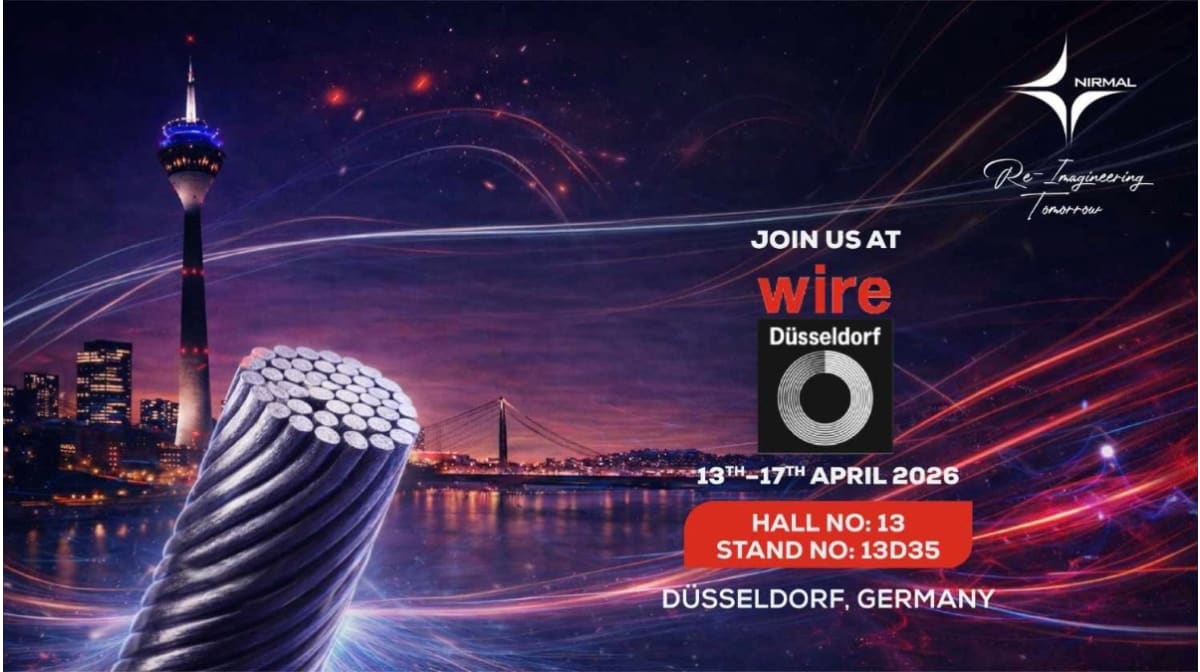
As part of this forward-looking approach and commitment to engaging with global industry developments, Nirmal Wires will be participating in wire Düsseldorf 2026 (Hall 13, Stall 13D35). This platform enables showcasing the company’s expanding portfolio of conductors and advanced wire solutions, while aligning with international standards, emerging technologies, and the evolving technical requirements of modern power grids.
Evolution of power grids: digital substations and new requirements
The growing adoption of digital substations is giving rise to new requirements in the industry. Digital substations reduce conventional copper control cabling by 30–50%, replacing it with fiber-optic and digitally monitored systems that are significantly less tolerant of variability. In this environment, conductor and cable performance must remain stable not only electrically, but dimensionally and mechanically over decades. This has driven industry-wide emphasis on insulation integrity, electromagnetic compatibility, fire performance, and installation precision. For manufacturers, the consequence is clear: process variation that might once have been acceptable now directly affects system reliability and lifecycle cost. In parallel, the boundary between “passive” and “active” grid assets is steadily disappearing. Optical ground wire (OPGW) adoption and fiber-enabled conductors are enabling real-time monitoring of temperature, sag, and mechanical stress across transmission networks. These systems can reduce unplanned outages by 20–30% through predictive maintenance. Right-of-way constraints are another defining factor reshaping industry economics. In densely populated and environmentally sensitive regions, corridor acquisition timelines can exceed 5–7 years, making physical expansion increasingly unviable. As a result, reconductoring and thermal uprating now account for a growing share of transmission investment. This has accelerated demand for high-strength steel core wires and advanced aluminum conductors capable of continuous operation at 150–200°C, compared to 75–85°C for conventional systems. These applications place a premium on coating adhesion, corrosion resistance, and fatigue performance—shifting value toward manufacturers that can demonstrate repeatable, field-proven results.
Nirmal’s expansion plans are aligned with this trajectory. The approved phased expansion at the Khordha unit in Odisha enables an additional 60,000 metric tons per year (approximately 5,000 metric tons per month) of aluminum conductor capacity, supported by an investment of ₹150 crore. This expansion is structured to scale output while preserving process stability and quality discipline. In parallel, the AAC and ACSR conductors manufactured at Deulti have received approval from Power Grid Corporation of India Limited, positioning Nirmal to participate directly in national transmission programs, renewable evacuation corridors, and reconductoring projects.
Product development is focused on the future. The company is moving beyond traditional conductors to explore advanced solutions such as ACAR and ACSS, which can provide a 15–30% increase in current capacity within existing corridors. On the steel wire side, zinc–aluminium alloy coated products, including the NIZNAL® range, offer up to 6 times the corrosion life compared to conventional galvanized wires. This directly addresses the grid’s increasing emphasis on lifecycle durability in coastal, industrial, and high-pollution environments.
Underlying these initiatives is a consistent operating philosophy: growth must be supported by measurable capability. Investments in energy efficiency, material yield improvement, and process automation are pursued not only for sustainability outcomes, but because they improve consistency and long-term reliability. As India’s grid becomes larger, more digital, and more constrained by physical limits, the role of wires and conductors is becoming more technically demanding. Nirmal’s focus remains on strengthening capability ahead of demand—so that progress is grounded in data, engineering logic, and an understanding of how the grid will be required to perform over the next several decades.
